
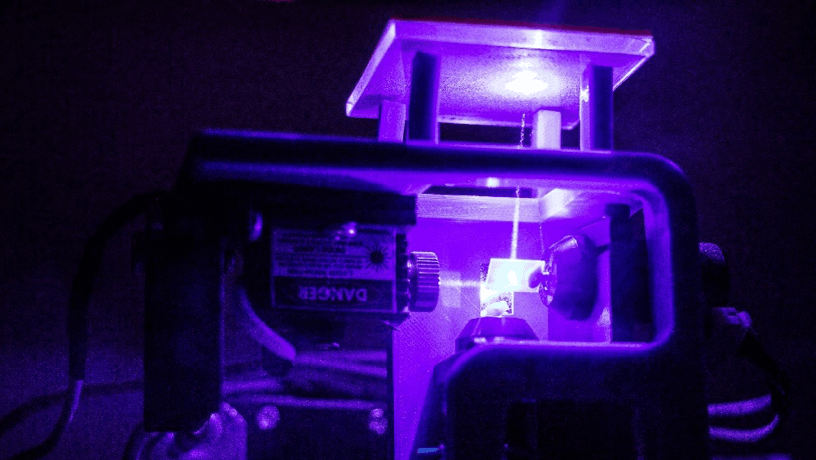
Printing a part that is made of multiple materials has been possible with fused deposition modeling and inkjet 3D printing technologies, though not so much with selective laser sintering (SLS), where a part is constrained to a single uniform material. Multi-material powder 3D printing, while not a new concept, had been challenging to develop up until now.
In the first quarter of this year, Belgian manufacturer Aerosint announced successful tests in printing bi-metallic parts using stainless steel and copper alloys, and is working to develop its proprietary laser powder bed fusion technology that combines metals and polymers, separately or simultaneously, including PEEK, PPS, and potentially ceramics and organic materials. Advancing 3D printing technologies such as SLS, to include multi-materials, would expand their scope far beyond the applications and possibilities of single material parts–which is what most real-world parts are like.
Researchers Hod Lipson and John Whitehead at the Department of Mechanical Engineering at Columbia University (U.S.) have developed a novel method using an inverted laser and transparent glass plates to print multi-material parts using SLS technology. In their SLS approach, the laser does not point downward into the powder bed, but upward.
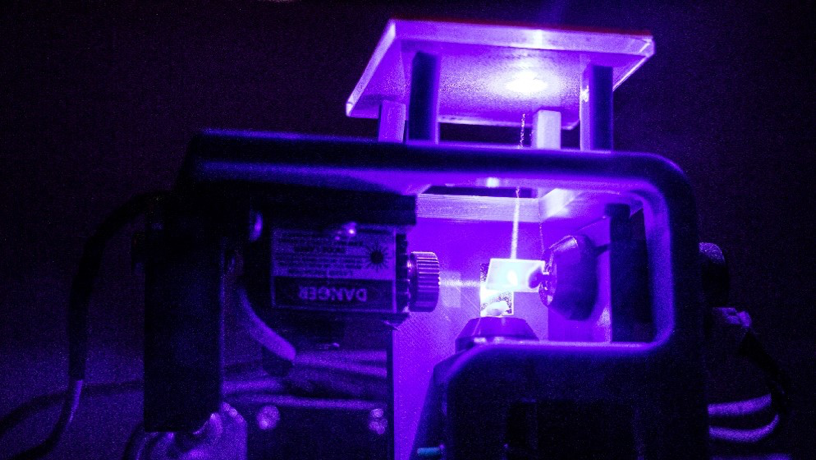
Upward pointing laser in SLS at Columbia. Image Courtesy of Columbia Engineering
Instead of the powder bed, thin layers of powder material are coated onto glass plates, and the laser is directed through a bottom glass plate to fuse the layer. The plate with the selectively fused material (using a pre-programmed virtual blueprint) then lifts and moves to another plate, coated with a different material, and the process repeats.
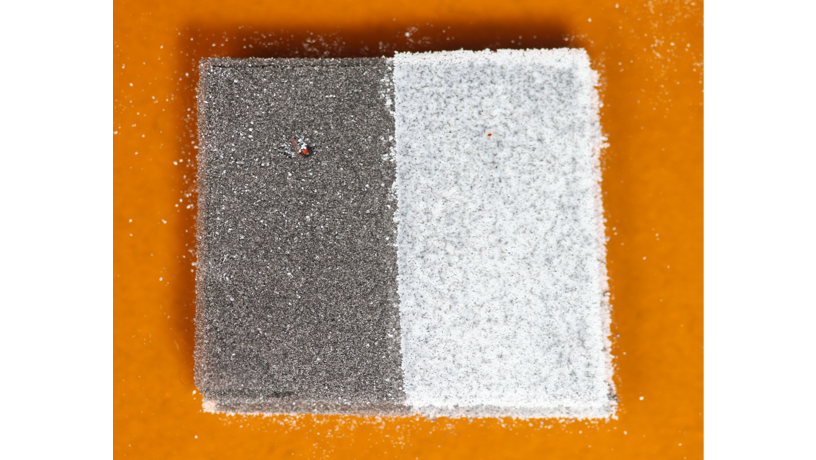
Multi-material concept part using SLS. Image Courtesy of Columbia Engineering
With the selective fusion, and multiple material glass plates (that also eliminate the need for a powder bed, and economizes use of material) parts can be built that either combine materials in one layer, or form a stack of different materials in each layer. To validate their proof of concept, the researchers printed a 2.18 mm, 50 layer thick part using TPU, as well as a multi-material part combining nylon and TPU. Advances such as this in SLS 3D printing are significant, as Lipson points out, “Now, let me ask you, how many products are made of just one material? The limitations of printing in only one material has been haunting the industry and blocking its expansion, preventing it from reaching its full potential.”
What this approach also allows is a full-view of the printed part as it is being printed – as opposed to only being able to view it (or identify defects) once it emerges and is dusted from the powder bed. John Whitehead explained this limitation,
“…in a standard printer, because each of the successive layers placed down are homogeneous, the unfused material obscures your view of the object being printed, until you remove the finished part at the end of the cycle. Think about excavation and how you can’t be sure the fossil is intact until you completely remove it from the surrounding dirt. This means that a print failure won’t necessarily be found until the print is completed, wasting time and money.”
It is worth noting that Aerosint’s approach, compared to that of the researchers at Columbia, does use powder beds, with a downward pointing laser and multiple rollers to deposit and fuse just the required amount of powder for each layer pattern.
“This technology has the potential to print embedded circuits, electromechanical components, and even robot components. It could make machine parts with graded alloys, whose material composition changes gradually from end to end, such as a turbine blade with one material used for the core and different material used for the surface coatings,” noted Lipson. “We think this will expand laser sintering towards a wider variety of industries by enabling the fabrication of complex multi-material parts without assembly. In other words, this could be key to moving the additive manufacturing industry from printing only passive uniform parts, towards printing active integrated systems,
This is why the team at Columbia Engineering is continuing to expand their research to include resin and metallic materials, with a much wider combination of properties – and perhaps in the near future, the limitations of 3D printing in multi-material parts, at scale, will be eliminated, and businesses or consumers could print real-world parts or devices on-demand, that can actually be used directly from the printer.
The post Columbia Researchers Develop Multi-Material SLS 3D Printer without Powder Bed appeared first on 3DPrint.com | The Voice of 3D Printing / Additive Manufacturing.
from Your daily news from 3DPrint.com https://bit.ly/2XkLY0g
Where to Buy Filament
Disclosure: Some of the links below are affiliate links. If you make a purchase, we may earn a commission at no extra cost to you. This helps support this site.
- Nylon: Hatchbox, eSUN, Overture
- PEEK: Hatchbox, eSUN, Overture
- PPS: Hatchbox, eSUN, Overture
- TPU: Hatchbox
These links go to Amazon with our affiliate tag. If you prefer to support local retailers or buy directly from manufacturers, we encourage that as well!
Related Articles
Frequently Asked Questions
What is metal 3D printing?
Metal 3D printing (additive manufacturing) builds metal parts layer by layer using techniques like laser powder bed fusion, directed energy deposition, and binder jetting. It enables complex geometries impossible with traditional manufacturing while reducing material waste significantly.
How strong are 3D printed metal parts?
3D printed metal parts can achieve mechanical properties comparable to traditionally manufactured metals. Tensile strength and fatigue resistance depend on the process and post-processing, but many meet or exceed ASTM standards for wrought materials.
What are the main metal 3D printing technologies?
The primary technologies include Laser Powder Bed Fusion (LPBF), Electron Beam Melting (EBM), Directed Energy Deposition (DED), Binder Jetting, and Metal FDM (with bound filaments). Each has different strengths in terms of resolution, speed, and material options.
📌 Related Articles
- Best 3D Printer Upgrades That Actually Improve Print Quality: Complete 2026 Guide
- 3D Printing Tungsten Carbide: How Hot-Wire Laser Technology Creates Metal Harder Than Steel
- The Current State of Metal 3D Printing in 2020
- Best Budget 3D Printer Upgrades That Actually Improve Print Quality: Belts, Springs, Hotends & More
- 3D Printing News: Multi-Material Breakthrough and Aerospace Market Boom